Neural DSP’s Quad Cortex Mini: Compact Powerhouse Delivers Professional Amp Modeling
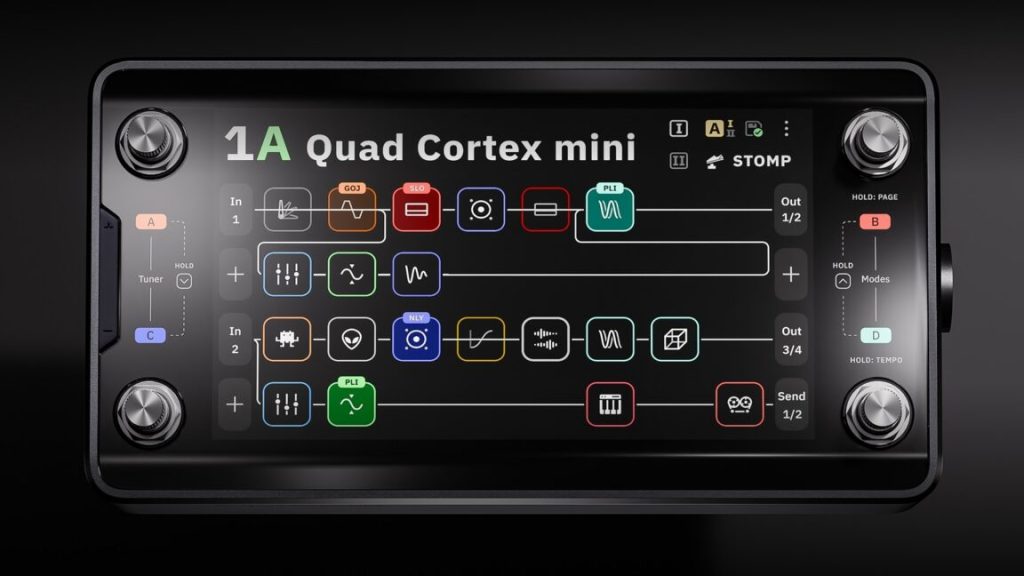
Neural DSP has captured significant attention in the music technology world with their latest innovation, earning recognition at the recent NAMM show in Los Angeles. The Finnish company, founded by Chilean immigrants in 2017, has established itself as a formidable player in the guitar amp modeling industry through advanced machine learning and impulse response technologies.
Operating from the Helsinki region, Neural DSP has revolutionized how guitar amplifier modeling software is created, competing with established giants like Universal Audio, Kemper, Line 6, and Fractal Audio. Their software plugins, priced around $100, can replicate the sound of expensive recording chains worth thousands of dollars, including amplifiers, speaker cabinets, effects pedals, and microphones.
The company expanded into hardware in 2020 with the original Quad Cortex, a floor-based unit featuring multiple footswitches that could replace entire warehouses of guitar equipment. This device offered hundreds of amp models, cabinet simulations, and effects in a single package.
Revolutionary Modeling Technology
The breakthrough in Neural DSP’s approach comes from machine learning technology that focuses on input and output signals rather than circuit modeling. This method analyzes how devices transform audio signals without requiring detailed knowledge of internal circuitry, significantly accelerating the modeling process.
In 2024, the company introduced TINA, a robotic system that automates the capture process. This robot manipulates physical controls on real amplifiers and effects units, recording thousands of different parameter combinations. A neural network then creates dynamic models that can respond to parameter changes just like the original equipment.
The latest iteration, the Quad Cortex Mini, maintains the full processing capabilities of its larger predecessor while reducing size by half and cutting the price to $1,400. This compact version features four footswitches instead of the original’s eight, making it more accessible while preserving all the advanced modeling technology.
Hardware Design and Features
The Quad Cortex Mini measures approximately 8.9×4.6×2.5 inches and weighs 3.3 pounds, constructed from premium glass, metal, and steel materials. Despite its compact size, it functions as a sophisticated computer running the proprietary CorOS operating system, complete with Wi-Fi connectivity for updates and cloud services.
The device features a 7-inch touchscreen interface and requires about 45 seconds to boot up. Users can monitor CPU usage through an integrated performance meter, ensuring optimal operation even with complex effect chains. The unit includes a complete monophonic synthesizer that can be layered with guitar sounds, offering extensive parameter control across multiple pages.
Connectivity options are comprehensive, including guitar and bass inputs, XLR input with phantom power, balanced XLR outputs, TRS send/return loops, stereo line outputs, MIDI connections, expression pedal input, USB-C port, and headphone output. A specialized “capture out” port enables users to create their own models of external equipment.
Extensive Sound Library
The Quad Cortex Mini ships with over 90 amplifier models, more than 100 effects, and over 1,000 cabinet impulse responses. Users can also access versions of Neural DSP’s desktop plugins and over 2,000 factory Neural Captures. The free Cortex Cloud service provides access to additional content, including user-generated captures and presets.
This single device essentially contains digital representations of hundreds of thousands of dollars worth of professional audio equipment. The routing capabilities allow for complex signal chains that can split, merge, and process audio in ways that would be impossible with traditional analog gear.
User Interface Considerations
The CorOS interface adopts a functional, grid-based design that prioritizes utility over visual appeal. The main screen displays effect chains as colored rectangles arranged in a grid pattern, with up to four rows of eight effects each. While this approach maximizes functionality, it lacks the polished graphics found in Neural DSP’s plugin interfaces.
The device offers multiple operating modes: Preset mode for switching between complete configurations, Scene mode for parameter variations within presets, Stomp mode for individual effect control, and hybrid modes for advanced users. A “Gig View” provides large, clear displays of footswitch functions for live performance situations.
Navigation can be complex due to the numerous interaction methods available, including touchscreen controls, rotary encoders, various tap and swipe gestures, and footswitch combinations. The companion Cortex Control desktop application significantly simplifies preset creation and organization tasks.
Audio Performance
The sound quality demonstrates Neural DSP’s expertise in amplifier and effects modeling. The device excels both for solo practice and recording applications, offering remarkable tonal variety and authenticity. Professional musicians including Dave Mustaine and John Mayer have incorporated Quad Cortex units into their live rigs, testament to the technology’s reliability and sound quality.
The extensive gear library covers virtually every major amplifier manufacturer, including Bogner, Marshall, Mesa Boogie, Matchless, Soldano, Vox, Fender, and Hiwatt. Bass players receive dedicated support with 13 bass amplifier models and specialized effects. The emphasis tends toward rock and metal tones, reflecting Neural DSP’s heritage, though sufficient variety exists for funk, blues, jazz, and country applications.
Recording and Capture Capabilities
For recording applications, the Quad Cortex Mini functions as a 24-bit, 48 kHz USB audio interface, eliminating the need for separate recording equipment. Multiple input channels allow simultaneous recording of dry and processed signals, enabling re-amplification workflows for maximum flexibility during mixing.
The device supports two capture methods for modeling external gear. Neural Capture Version 1 operates locally on the device, suitable for overdrive pedals, amplifiers, and cabinets. The more advanced Neural Capture Version 2 utilizes cloud-based processing for higher-resolution models, particularly effective for touch-sensitive devices like compressors and fuzz pedals. Users receive 40 cloud capture sessions daily, each requiring approximately 10 minutes to complete.
Market Position and Value
At $1,400, the Quad Cortex Mini occupies the premium segment of the modeling market. Potential buyers should consider their specific needs when evaluating alternatives. The smaller Nano Cortex at $570 offers fewer features but maintains core functionality, while the full Quad Cortex at $1,800 provides additional footswitches and expanded capabilities.
For guitarists who cannot distinguish between modeled and authentic amplifier sounds, the device represents exceptional value considering the cost of equivalent hardware. Individual professional amplifiers often exceed the Mini’s entire price, making the comprehensive gear library economically attractive.
However, recording-focused musicians might find Neural DSP’s software plugins or alternatives like Universal Audio’s Paradise Guitar Studio more suitable for studio work. The open-source Neural Amp Modeler (NAM) provides free modeling capabilities with community-shared content, though with more limited dynamic range compared to commercial solutions.
The Quad Cortex Mini succeeds as a versatile platform for home practice, live performance, and recording applications. While the interface complexity requires investment in learning, the sonic capabilities and comprehensive feature set justify the premium pricing for serious guitarists and bassists seeking professional-quality amp modeling in a compact format.